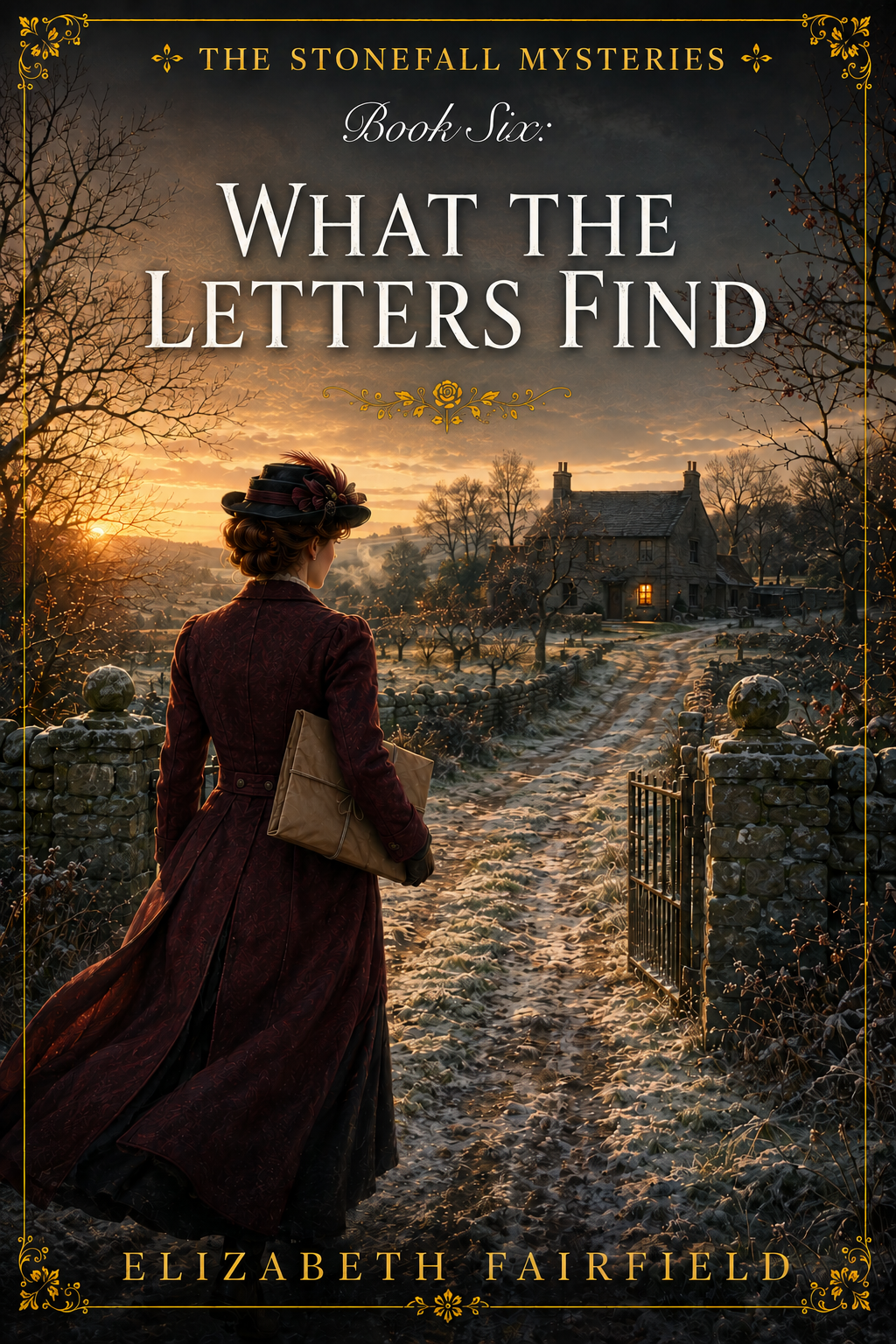
What The Letters Find
Book 6
$4.99
Every family keeps two kinds of history: the one it tells, and the one it buries. In the sixth Stonefall Mystery, Mira and Philip Vane discover that sometimes the two are separated by nothing more than a name nobody thought to say aloud — and a hundred and forty-four years.
Spring comes to the Eden Valley the way it always has: unhurried, certain of itself, indifferent to the fact that this year it arrives carrying a wedding. Mira Ashworth becomes Mira Vane on a Saturday in April, in a small register office in Appleby, surrounded by four years' worth of people who have watched her become, without quite noticing the moment it happened, entirely at home. It is the kind of day the valley does well — small, warm, and witnessed by everyone who matters, whether or not they were formally invited.
But a household like Stonefall's has never yet gone a season without something arriving that wants attending to, and this one is no exception. Tucked among the wedding correspondence is a stranger's letter, forwarded almost as an afterthought — the record of a marriage, 1761, found by a schoolgirl with a habit of looking twice at things everyone else has already decided are unremarkable. A name: Eliza Vane. A place: Kirby Lonsdale, a market town no one in the family has visited in living memory. And a question that has waited a hundred and forty-four years to be asked properly: what happened to the Vane daughter who went south, and why has no one in four generations been willing to say her name?
What begins as a genealogical curiosity becomes, chapter by patient chapter, something closer to an excavation — of land settlements and account books, of a debt between two men who died before their grandchildren were born, of a family memory carried, unspoken, down two separate lines for a century and a half, each side certain of a different, incomplete version of the truth. Philip Vane, solicitor by training and by temperament, follows the paper the way he follows every case: carefully, without hurrying toward a conclusion the evidence hasn't yet earned. Mira follows the people. And an unlikely correspondent in Leeds, an archivist's assistant with more patience than either of them, and a fourteen-year-old girl with an archivist's exacting eye of her own, each turn over their piece of the puzzle until three separate accounts — a marriage register, a solicitor's ledger, and a family's oral history — begin, finally, to say the same true thing.
At the center of it all is Robert Vane: solicitor's father, recent and reluctant convert to Sunday dinners at a table that was never obligated to welcome him, a man who has spent most of his sixty-seven years believing his family's one great shame was a scandal too painful to name. What he learns instead — slowly, and not without its own kind of grief — is both harder and kinder than the story he was raised on: not a disgrace hushed up, but a debt honestly incurred and, eventually, honestly paid. The land his family always called an inheritance was never a gift. And the woman at the far end of that hundred-and-forty-four-year silence, when she is finally found, turns out to be waiting on the other end of it with a letter of her own.
This is a mystery of the quietest kind — no body in the orchard, no midnight intruder at the gate, only the slow, deliberate work of people who have learned that most of what goes wrong between families goes wrong not through malice but through silence, and that the remedy for silence is rarely dramatic. It is a letter, sent and answered. A ledger, read carefully. A woman deciding, at last, that she would rather know an uncomfortable truth than go on protecting herself from an imagined one.
Readers who have followed the Stonefall Mysteries from the beginning will find every familiar pleasure here: Mrs Calloway's rare and devastating verdicts, delivered from the range without ever quite raising her voice; Ellen Harker's notebook, filling steadily with the permanent things of a childhood spent watching adults solve problems by paying close attention; the particular, unhurried rhythm of a valley that keeps its own record of everything that happens within it, official and unofficial both, and trusts that record more than it trusts any single person's memory. New readers will find a novel that stands entirely on its own — a story about the cost of unspoken things, and the particular grace of a family finally willing to ask the question it has spent generations avoiding.
By the book's close, as the damson jars line the shelf and the hellebores settle in for another winter, the ledger between the Vanes and the family they lost is, at last, balanced — the debt repaid twice over, once in acres and once in the far more valuable currency of simply being known. But even a valley this thorough about keeping its accounts cannot close every book at once. A letter arrives in the novel's final pages, addressed to no one in particular and everyone at once, carrying a name that has not yet found its way into anyone's ledger: a second daughter, lost somewhere between one generation's certainty and the next one's forgetting, waiting — as every thread in this valley eventually does — for someone patient enough to go looking.
What the Letters Find is a novel about the particular kind of love that shows itself not in grand gestures but in the willingness to read something difficult all the way through — a letter, a ledger, a person — rather than looking away. It asks what a family owes the people it has let go quiet, and what it costs, and what it's worth, to finally pay that debt in full.
The valley remembers. The question, as always, is whether anyone is willing to ask it what it knows.
---
The Stonefall Mysteries continue in Book Seven.